

Starters
Snow
Flakes drifting down in a breeze, from a wide emitter overhead, on the sidebar's own settings.
VecFlow 0.1.0
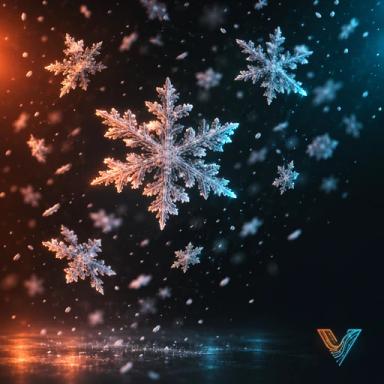
Flakes drifting down in a breeze.
SidebarVecFlowNew SimulationParticlesSnow, or AddVecFlowSnow.
What it makes
Objects it makes
Snowmesh, the simulation: it holds the settings and plays the bake
Snow Emitterempty, where the particles come from
No flow: the sidebar’s settings, changed from their defaults
Per Frame 120, Speed 0, Spread 0.2, Life 6, Variation 1, Drag 8, Wind 0.6, 0, 0, Turbulence 1.5, Swirl Size 0.6, Swirl Change 0.4, Bounce 0, Friction 1, Scale 0.8, Variation 0.4, Colour Fixed, Colour 0.92, 0.95, 1, Variation 0.03, Radius 0.008
The emitter is 3 m across, 3 m above the cursor. Flakes are born with no speed of their own; high Drag holds them back against gravity, so they fall slowly and the breeze (Wind) and turbulence carry them. They stop where they land (no bounce, full friction) and live about 6 seconds.
Try these first
- Per Frame: 120 a frame is light snowfall; 1,000 a blizzard (raise Wind with it).
- Drag: lower and the flakes fall faster, like sleet; higher and they float.
- Strength: more for flurries that swirl, 0 for flakes falling straight.
Make it yours
- Cover your shot. Scale the emitter (an Empty: scale it in X and Y) to cover what the camera sees, and lift it out of frame.
- Make it last. Raise Life so flakes on the ground stay longer, or turn Lifespan off to keep them all.
- Real flakes. Point Shapes at a collection of flake models.
- Size. Sphere Radius sets how big the flakes show, without a new bake.
Related
- Forces: drag, wind and turbulence
- Playback and the viewport: a lighter viewport for heavy snow