

Honey Pour
Thick honey pours onto a wooden rod, wraps it and drips off in strings, with air bubbles in it and a glassy gold surface.
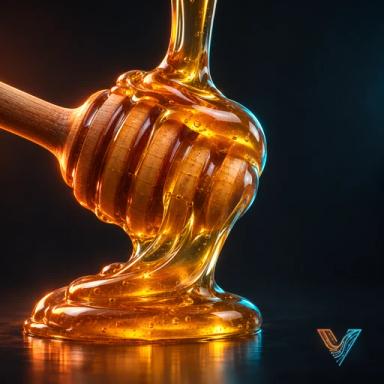
Thick honey pours onto a wooden rod, wraps it and drips off in strings, with air bubbles in it and a glassy gold surface. Real size: a 3 cm rod. Halve the Liquid's Spacing for the final bake.
SidebarVecFlowNew SimulationSmoke, Fire and WaterHoney Pour, or AddVecFlowHoney Pour.
What it makes
- Birth: Mode Fill, Object Honey Nozzle, Stop On, End 120, Velocity 0, 0, -0.1
- Gravity
- Liquid: Spacing 0.001, Density 1,420, Viscosity 0.03, Stringiness 1, String Break 2
- Collide: Object Honey Rod, Ground On, Bounce 0, Friction 0.3, Stickiness 2, Liquid Friction 0.5
- Whitewater: Rate 3, Speed 0.8, Bubbles Rise 0.0005
- Birth: Per Frame 120, Start 2
- Position: Object Honey Nozzle, In Volume
- Age Test: Age 0
It's at real size. A wooden rod 3 cm across (Honey Rod) lies 5 cm above the cursor. A small cylinder 8 cm above the rod's middle (Honey Nozzle, shown as wire and not rendered) is the emitter. Its Birth is a Fill with Stop: it keeps the nozzle full up to the scene's last frame, so honey pours out of it all along at 10 cm a second.
The Liquid operator makes it thick honey: particles 1 mm apart, about four times as thick as everyday honey (viscosity 0.03 m²/s), with no surface tension and Stringiness at its highest, so it draws out into strings as it drips. The Collide makes it stick to the rod (Stickiness 2) and slide along it slowly (Liquid Friction 0.5). It wraps the rod, hangs off its underside and drips to the ground.
It also has air in it. A Whitewater operator folds bubbles in where the honey lands on itself. A second event, Stream's Bubbles, sends air down the stream. Both kinds go to the Bubbles event and ride along with the honey. This thick, they hardly rise. Each shows as one small ball in the Air in Honey material, which bends light the opposite way to honey.
The bake adds Honey Liquid, the honey's surface, in the Honey material. It's clear and refracts like honey, reading gold where thin and amber where deep. The surface uses Sheets with Smoothness and Fill Creases at 3, so it's smooth and glassy rather than lumpy.
Try these first
- Edit FlowHoneyLiquidSpacing: 1 mm keeps the bake quick. Halve it for the final bake: the streams stay whole and thin, and thin streams stay whole. Expect about eight times the particles.
- Edit FlowHoneyLiquidViscosity: lower is runnier. 0.007 is everyday honey, which runs off the rod sooner.
- Edit FlowHoneyCollideStickiness: higher holds more honey on the rod before it lets go; 0 lets it slide straight off.
Make it yours
- Your own dipper or spoon. Point the Collide's Object at your mesh, and move Honey Nozzle above it.
- A spoonful. Add a second Birth, a Fill of a closed mesh shaped like the honey in a spoon, on the first frame only.
- No bubbles. Turn off the Whitewater operator and the Stream's Bubbles event's Birth.
Related
- Liquid Looks: the surface's art controls
- Liquid, setting by setting
- Performance: spacing and bake times