

Starters
Sand
Grains pour from a spout into a real cone heap. A flow with Particle Physics and Static Friction.
VecFlow 0.1.0
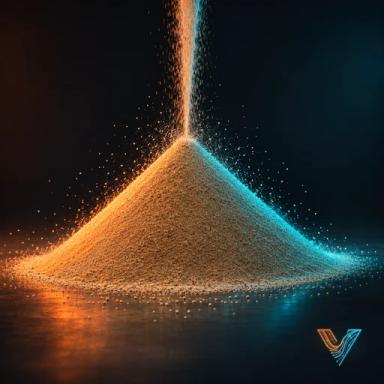
Dry sand pours from a spout into a cone that keeps its slope. Friction sets how steep it stands.
SidebarVecFlowNew SimulationParticlesSand, or AddVecFlowSand.
What it makes
Objects it makes
Sandmesh, the simulation: it holds the settings and plays the bake
Sand Emitterempty, where the particles come from
Its flow, “Sand”: one event
Event “Sand”
- Birth: Per Frame 30
- Position: Object Sand Emitter
- Gravity
- Colour: Colour 0.76, 0.6, 0.38, Variation 0.06
- Particle Physics: Radius 0.005, Density 1,600, Bounce 0, Friction 0.6, Static Friction 0.6
- Collide: Ground On, Bounce 0, Friction 0.6
Sidebar settings it changes
Substeps 10, Radius 0.005
The emitter is 60 cm above the cursor and pours 30 grains a frame, 5 mm across, through 10 substeps. Particle Physics makes them bump and hold each other: Friction and Static Friction, both 0.6, keep the heap's sides at about 35°. Grains live for ever, so the pile grows.
Try these first
- Edit FlowSandParticle PhysicsStatic Friction: with Friction, higher makes a steeper heap. 0.3 gives about 30°, 0.9 about 38°.
- Edit FlowSandBirthPer Frame: a faster pour fills the pile sooner, and bakes slower, as every grain touches its neighbours.
Make it yours
- Pour into something. Point Edit FlowSandCollideObject at a bowl or a box.
- Colour. Edit FlowSandColourColour, and its Variation for sand that isn't all one shade.
Related
- Sand and grains
- Performance: grains that touch cost more